


1
Open our Schedule form template
Start with our blank Schedule C form.
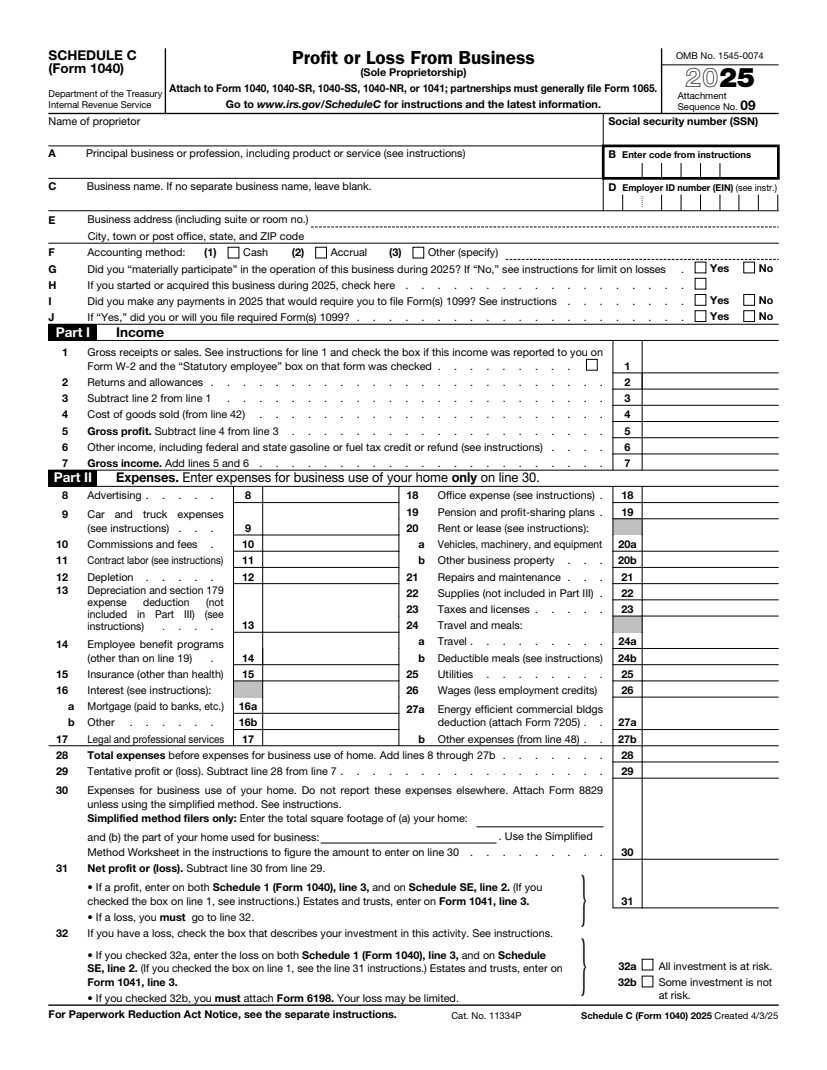
Add your business income and expenses using our simple Schedule C form, then download your completed document. It’s all done online in minutes.
 Click to start filling
Start with our blank Schedule C form.
Enter your income, expenses, and business information.
Save your completed 1040 Schedule C for filing.
The official template, not an outdated copy.
Sign on screen — skip the print-and-scan loop.
TIN spacing and dates format as you type.
Download the PDF; we don't keep a copy.
Schedule C (Form 1040), also called Profit or Loss From Business form, reports the income and expenses of a sole proprietorship. It calculates your business’s net profit or loss. You file it with your individual federal tax return.
You may need to complete Schedule C if you are:
I bring on ten to fifteen contractors a month and used to chase every one of them for a legible form. Now I send this link in the offer email and the signed PDF comes back the same day.
Half our vendors used to send forms as phone photos that finance refused to file. Pointing them here fixed it. The layout matches the official document and nothing gets cut off when it downloads.
What sold me is that the data isn't stored anywhere and the file downloads straight to the signer's machine. I can ask a client to complete one without worrying about where their details end up.
January used to mean tracking down paperwork from every subcontractor. This year I sent one link to the whole roster and had every form back inside a week.
New clients always want a fresh copy and I never have last year's handy. Filling it out here is faster than digging up the PDF, and the fields space themselves so I stop transposing digits.
I keep this bookmarked for the client who calls saying they need a form right now. I walk them through it on the phone in a couple of minutes — open, type, sign, download.
Most form questions come down to one confusing field. Ask in plain language and get an answer grounded in the official instructions, with an example for your situation.
Help for every box on the form
No tax jargon, real examples
Questions aren't tied to your form
Answers track the official form instructions — not generic web advice. When the form has a quirk, it explains it the way the instructions intend.
It explains what each box means and how people in your situation usually complete it. For a judgment call about your specific taxes, it'll point you to a professional rather than guess.
Review these common questions to understand how to complete and file your Schedule C tax form correctly.
Your net profit or loss from Schedule C, line 31, is entered on Schedule 1 (Form 1040), line 3. The total from Schedule 1 then flows to Form 1040, line 8.
Schedule C is a two-page form. It has five main sections. These sections cover: Income Expenses Cost of goods sold Vehicle use Other expenses
You’re typically required to file a Schedule C tax form if you’re a sole proprietor whose business has income or deductible expenses. This can include: Independent contractors Freelancers Gig workers Statutory employees Owners of single-member LLCs treated as disregarded entities
You can generally deduct ordinary and necessary expenses related to operating your business. Examples include: Advertising Supplies Business insurance Contract labour Professional fees Business travel Qualifying meals Rent of your office or premises Utilities Vehicle expenses Remember to keep records of each deduction for proof.
Vehicle basis is the amount used to calculate depreciation on a business vehicle. It usually begins with the vehicle’s cost. You then adjust it, taking into account factors like credits and previous depreciation. However, this is usually reported on Form 4562, not Schedule C.
Schedule C income is any money that you earn from your regular trade or business. You have to report payments that you received in cash, by card, bank transfer, payment platforms, or barter.
These are two completely different documents with different purposes. People paying you use Form 1099-NEC to report the transaction. In contrast, you complete a Schedule C form to report all your business income and deductible expenses.
You can report deductible vehicle expenses on Schedule C, line 9. Vehicle depreciation is generally reported on line 13, and vehicle lease payments can be reported on line 20a.
Depletion is a deduction for the reduction of natural resources used by a business. Examples include: Minerals Oil Gas Timber You enter an allowable depletion deduction on Schedule C, line 12.
A return is usually a refund you give a customer for something they bought that’s defective, or that they no longer want. An allowance is a discount on the original selling price that you give customers instead of a refund.
A self-employed person is usually required to fill out a Schedule C to report income and expenses from their trade or business. A $400 threshold applies to Schedule SE. You may still need to fill out a Schedule C if your net earnings are below $400.
A single-member LLC normally reports its business activity on its owner’s Schedule C. This applies when the LLC: Is disregarded for federal income tax purposes Has not elected corporate taxation
The principal business code is a six-digit code that describes your main business activity. The code you have to enter is based on the North American Industry Classification System.
If you’re a gig worker or freelancer, you need to report your total business income in Part I. Then, add your allowable expenses in Part II. You may also need to complete the sections regarding vehicle use or other expenses.
Any money you spend paying people you do not treat as employees for services performed for your business. You should generally report these payments on line 11.
You should complete the investment-at-risk section on line 32 when your business reports a loss. If some of your funds are protected from loss, check box 32b
There is no specific IRS income or profit threshold that indicates you should choose S corporation status. You should seek the advice of a qualified tax advisor to see if this is the best step for you.
You may need to file Schedule C if you have either: Deductible business expenses Made income this year but operated at a loss If your sole proprietorship had no income and no expenses for the entire year, then you typically do not have to file a Schedule C
Airbnb income is generally reported on Schedule E if you simply rent out the property, nothing else. Use Schedule C if you provide substantial services during the guests’ stay, such as: Regular cleaning Linen changes Maid service
Rental real estate income belongs on Schedule C when you provide substantial services to occupants during their stay/rental period. You typically report ordinary real estate rentals on Schedule E.
Qualifying business meals must be a normal, ordinary and necessary meal. It cannot be overly luxurious or lavish. You or your employee should be present for the meal. Business meals are generally 50% deductible.
Report business payments shown on Form 1099-K as part of gross receipts on Schedule C, line 1. You should keep this form with the rest of your records to avoid counting the same income twice.
There is no specific Schedule C deduction that automatically triggers an IRS audit. The IRS’ system is based on various factors. You may be flagged because your reported income does not match Form 1099, or because someone else doing their return has included your business and your figures do not match. You should get in contact with a qualified tax advisor to find out your next steps.
A PA Schedule C is used to report business or professional profit and loss in Pennsylvania. It’s a different form from the federal Schedule C. Pennsylvania has its own rules, so make sure you follow the instructions carefully or get advice from a tax professional.
Office expenses include office supplies and postage. You can include them on Schedule C, line 18.
The recovery period is the number of years over which a business asset is depreciated. You typically include it on Form 4562 rather than directly on your Schedule C.
Schedule C net profit is generally used as a starting point for calculating self-employment tax on Schedule SE. You normally must file Schedule SE when your net earnings from self-employment are at least $400. This tax covers Social Security and Medicare.
This is not the purpose of a Schedule C form. You should use Form 1040-ES to estimate your: Annual business profit Deductions Income tax Self-employment tax Then, subtract expected withholding and credits. This helps you determine whether quarterly payments are required. You typically need estimated payments if you expect to owe at least $1,000 after withholding and refundable credits.
You may qualify to use a simplified inventory method if you meet the IRS small business taxpayer test and are not a tax shelter. The gross receipts threshold changes every year. Make sure to check the current Schedule C instructions.
You should keep records for as long as they may be needed to support your tax return. It’s usually recommended to keep your records for three years at minimum.
No, a separate bank account is not a federal requirement for filing Schedule C. However, having a separate business checking account makes income, expenses, and supporting records a lot easier to track.
The cash method generally records income when received and expenses when paid. The accrual method generally records income when earned and expenses when incurred. Whichever method you use must clearly reflect income and follow any applicable inventory rules.